
Water, Earth, Air and Fire
Central and Eastern European artistic positions at the 61st Venice Biennale
In the summer of 2026, it was hard not to view the 61st Venice Biennale through the lens of climate anxiety and ecological crisis: not only did the city itself mirror these concerns, but several works in both the main exhibition and the national pavilions focused on them. As I wandered Venice during the August heatwave, I started thinking: how can art keep addressing these questions in new and exciting ways? This year I focused on the pavilions of Central and Eastern Europe and the Baltics, taking the four classical Greek elements as my starting point. By observing the presence of Water, Earth, Air, and Fire across several pavilions, a complex and sensitive understanding of the ecological crisis unfolded. In some cases, more explicit solutions emerged; in others, more obscure ones.
Water
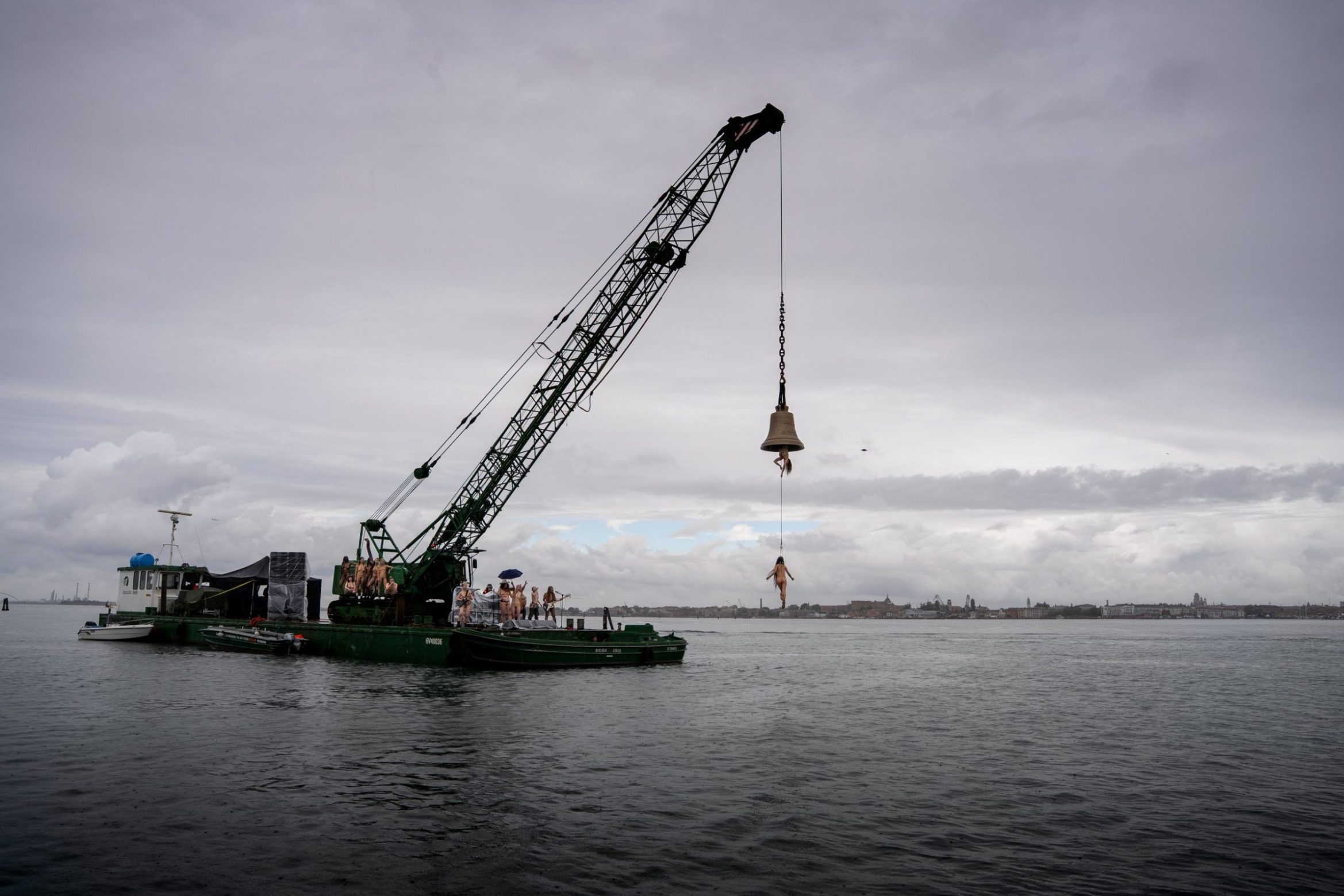
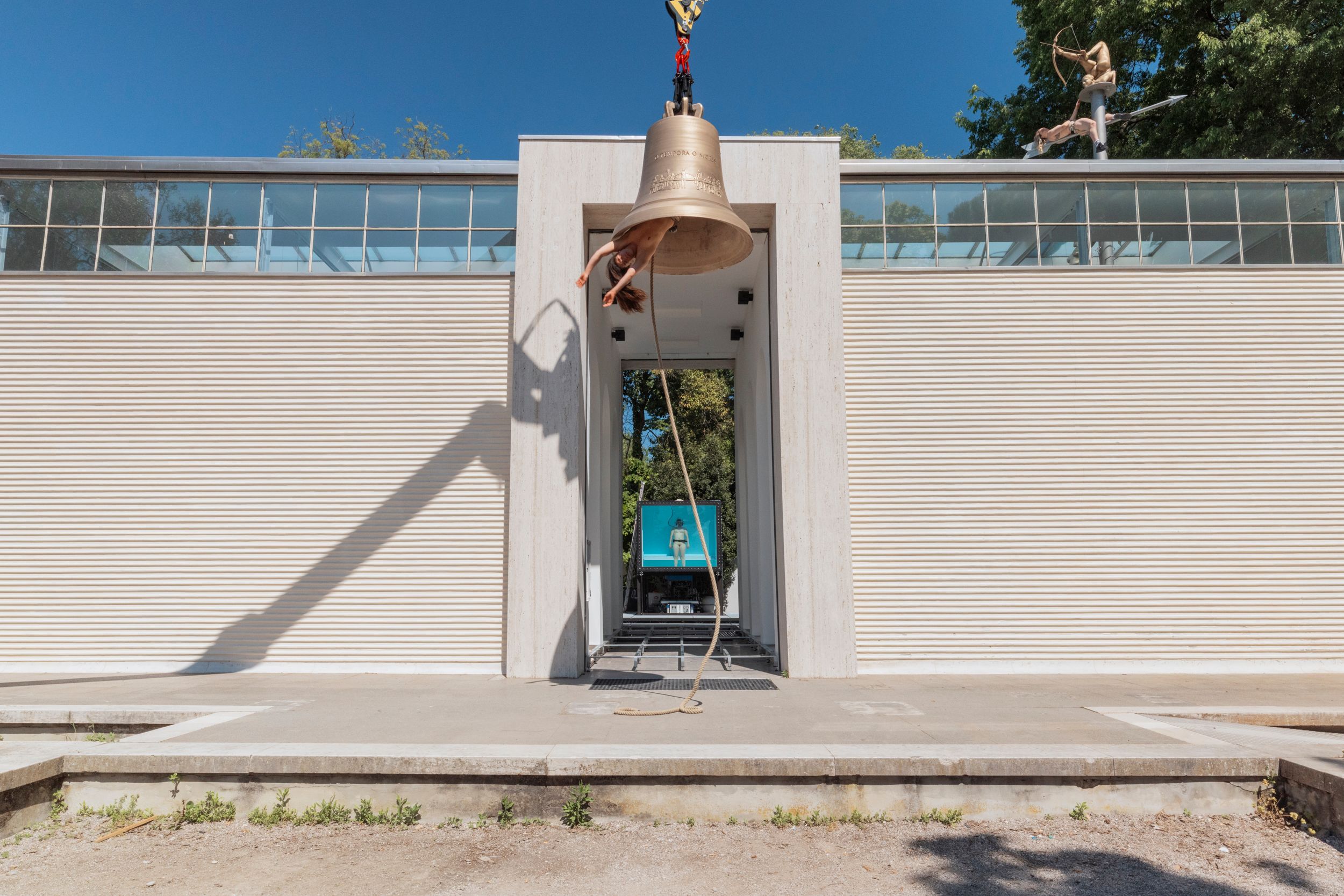
Several pavilions took water as their starting point, also reflecting on Venice’s history and current climate issues, as the city faces severe flooding and structural erosion caused by rising sea levels, sinking land (subsidence), and increasingly extreme storm surges. Among the most documented pavilions was the Austrian Pavilion, which presented Seaworld Venice, a project by dancer and choreographer Florentina Holzinger, curated by Nora-Swantje Almes. Echoing the summer of 2026 in Hungary when the energy crisis forced everyone to rethink their water use, the pavilion reflects on not only the rising sea levels, but also the water we “drink and excrete in countless cycles every day; water, a vital, life-sustaining natural resource and a highly managed commodity; water to plunge in, dive in and emerge from, perhaps transformed.”[1] In the pavilion, two portable toilets were installed that performers invited visitors to use, allowing their urine to be collected, filtered, and recirculated into the installation’s tanks. This metamorphosis of matter was already provocative enough, but Holzinger also combined the maintenance work and the transformation of water with other aspects: partly an amusement park, partly a mythological scene with contemporary “sirens”. The performative project made us reflect on our relationship with water and how we use it. The “first” scene during which the performer hung herself from a huge bell was for me the most captivating. It always marked the start of the performance and evoked a notion of grievance, alertness, and danger, as if the strong yet fragile human body’s presence as the bell’s clapper would be a wake-up call about the crisis we live in. Even though the hype was probably bigger than the experience itself, the core idea of Holzinger’s project, with its different components, showed in a sometimes playful, sometimes disturbing, sometimes monumental way the ambiguous relationship between purity and pollution, sacred and profane, flooding and dryness.
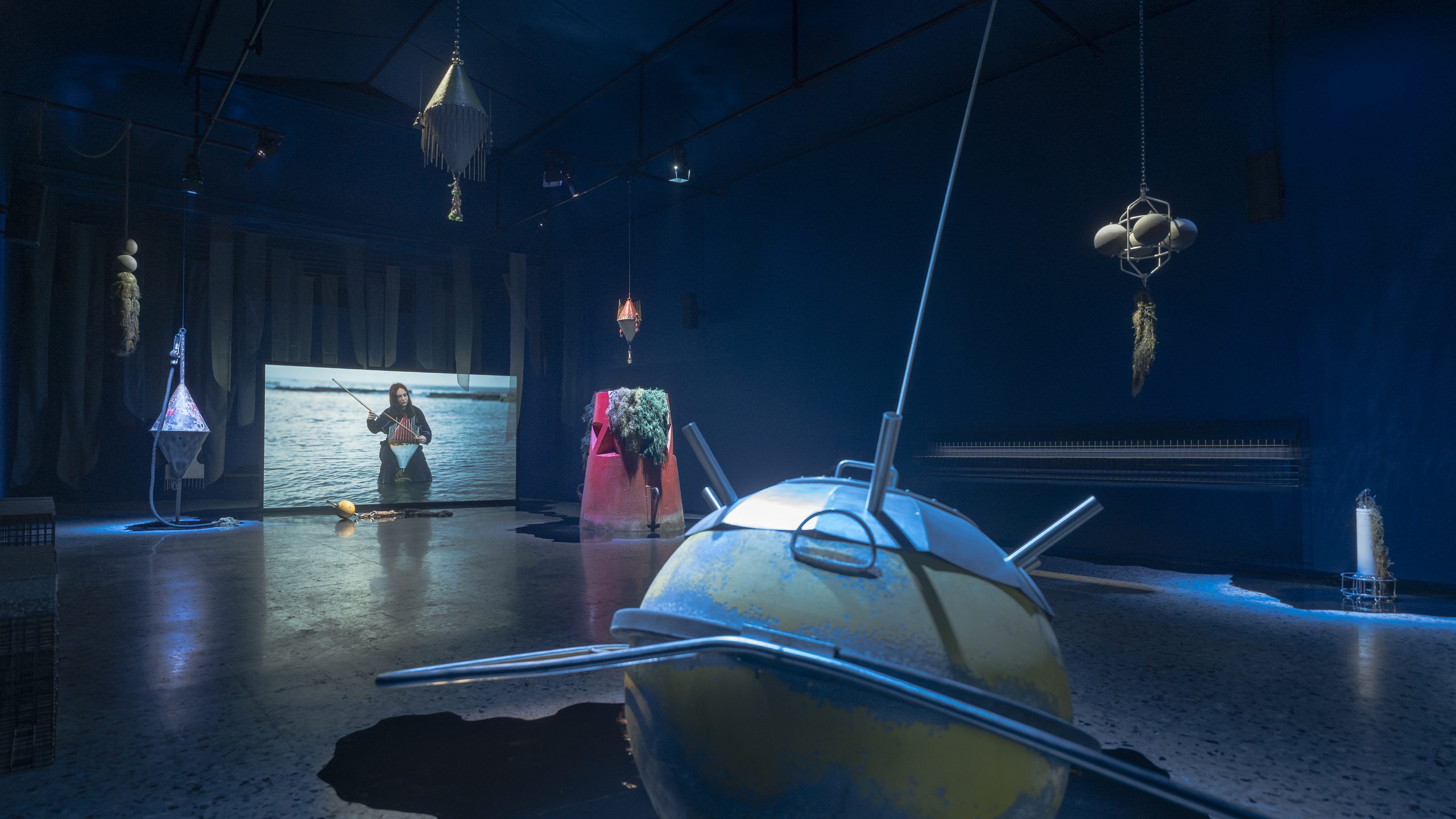
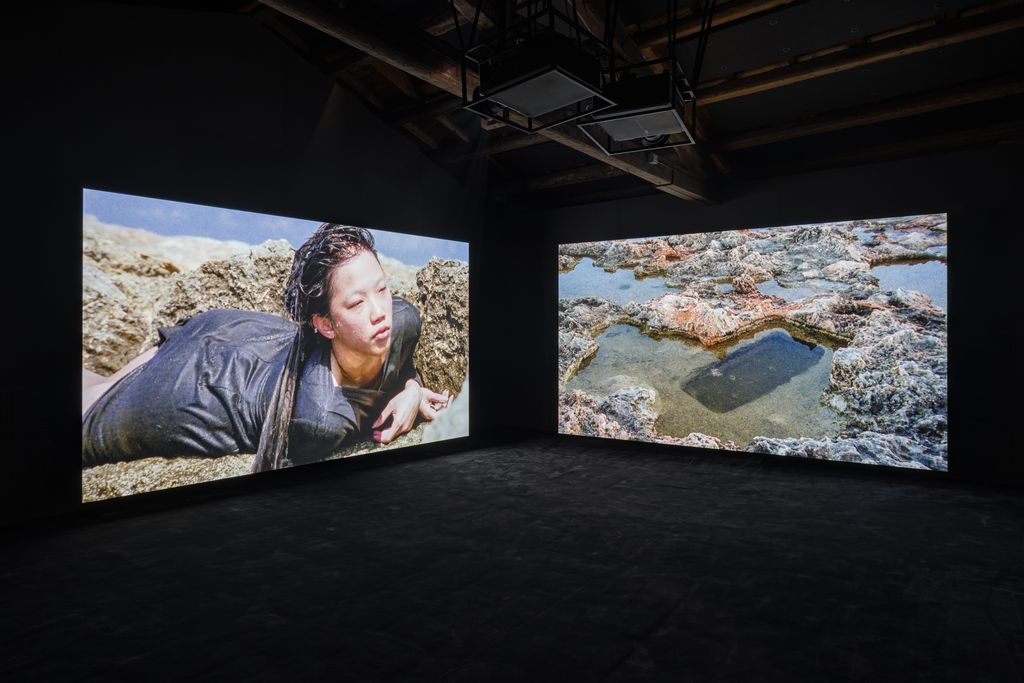
The Black Sea was the focus of the Romanian Pavilion, by artists Anca Benera and Arnold Estefán, curated by Corina Oprea and Diana Marincu. In Black Seas – Scores for the Sonic Eye, the viewer encountered various ways to engage with that body of water itself. On the pavilion’s façade, textile flags carried sonar images of the seabed, with the courses of major rivers embroidered across them. Inside, though, the installation became the most unique experience for me. It engaged all the senses through touch, sound, and smell. It seemed to me it was possible to perceive it on different levels – if somebody wanted to dig deep into the history of the sea as a “living archive,” thorough research by the artists and their collaborators was supporting that, but it was also working on an aesthetic level too. The two-channel video installation was surrounded by buoys from the Black Sea, the Atlantic, the Mediterranean, the Baltic and the Adriatic. Transformed into sound-producing sculptural instruments, these strange but mesmerising objects twisted and turned as they hung from the ceiling. Their movement and sound could have been perceived as a welcome to the space, and it continued its way into the film. In this ritualistic moving-image work, we can observe how performer Diana Miron engages in dialogue with the sea. Although we don’t understand what passes between Miron and the sea, their intimacy is clear. The woman could perform an invocation, a lament, a plea, or simply a conversation that emerges in the language of music and sound. It seems to be a foreign language, one we do not comprehend intellectually but can still understand emotionally. As the sea’s oscillations are translated into sound, Miron’s body and the sea become one, constantly entangled with one another. Underwater scenes add a microperspective to the above-mentioned narrative.
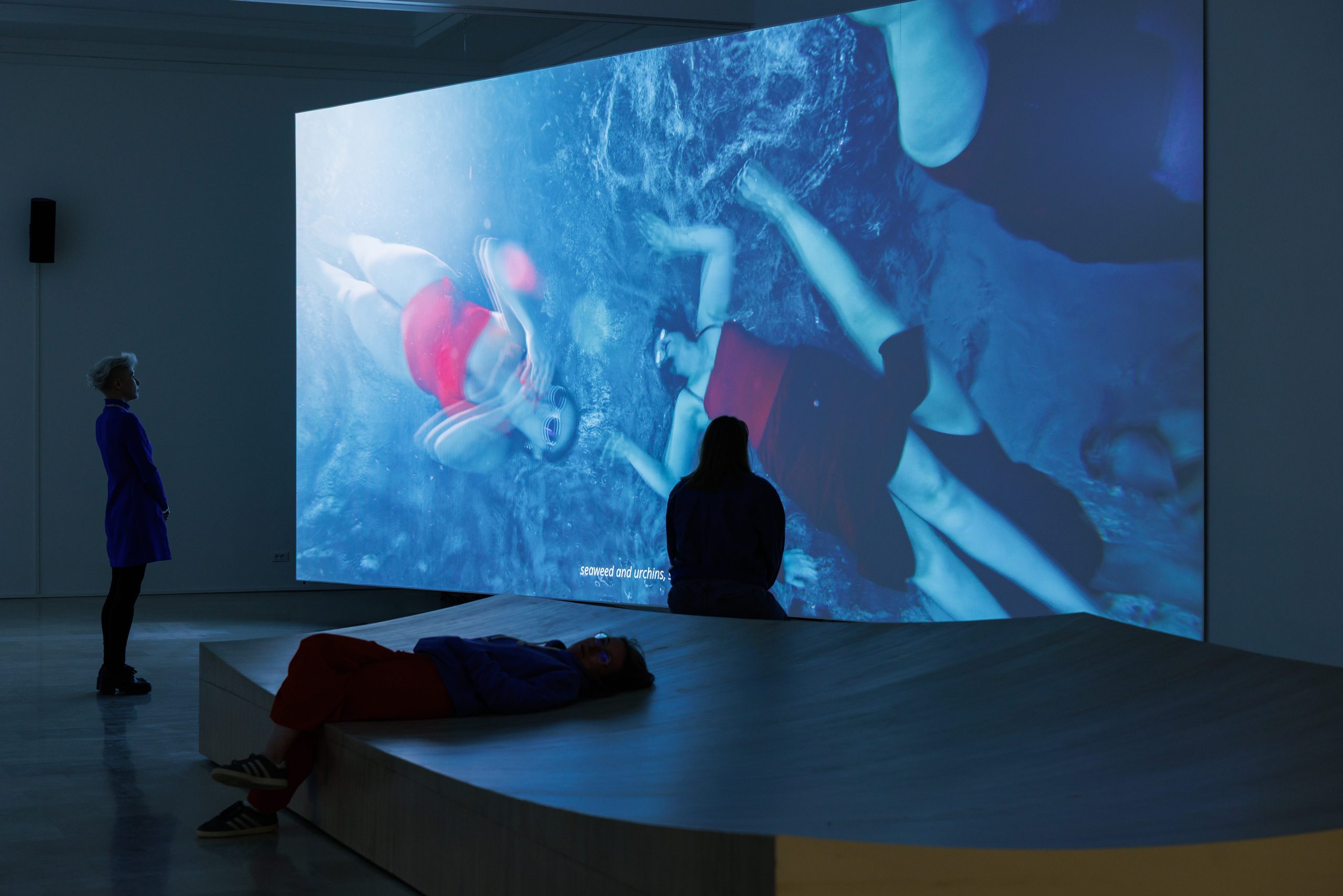
The Polish Pavilion’s exhibition, titled Liquid Tongues by Bogna Burska and Daniel Kotowski, curated by Ewa Chomicka and Jolanta Woszczenko, brings together seemingly very distinct fields, from crip theory and accessibility to alternative forms of communication with more-than-human beings. If I wrote that the Romanian Pavilion had an immersive quality, the Polish one was even more so. The huge two-channel video installation was arranged so that viewers could lie back on benches, look up at one screen and glance over at the other. On paper, the concept seems a bit complicated and heterogeneous, so I’ll start with its immediate effect: watching and listening to the social Choir in Motion, made up of hearing and Deaf performers who interpret whale communication and songs, using the sound of English phonics and International Sign languages simultaneously. The most powerful scenes were those in which the choir was “singing” underwater in red costumes, the sign language transforming into its own kind of choreography: one screen showed the “real” action, the other upside down. Alicja Czyczel’s choreography and Aleksandra Gryka’s music were captivating, and one of the tunes was so catchy that I still remember it. Inspired by Roger Payne’s legendary recordings, Songs of the Humpback Whale (1970), which led to a ban on whale hunting and saved them from extinction, the project explores marginalized forms of language and communication. It draws attention to voices often overshadowed by dominant ones, including those of animals, Indigenous communities, and disabled people. As they summarize, “it is a tale about breaking with the oppression of phonetic training and building Deaf subjecthood.”[2] The participatory aspect of the film, through the choir, the collective of hearing and Deaf people, and the emphasis and connection with underwater realms and endangered species, made the whole project highly topical.
Earth
The exhibitions at the Czechoslovak Pavilion, The Silence of the Mole, curated by Peter Sit, bring together several cultural references relevant to the Czech Republic, from Franz Kafka to The Little Mole (known in Czech as Krtek or Krteček, well familiar to children and adults across the former Eastern Bloc). Through this unusual combination, the project explores empathy, self-sacrifice, dominance, and exploitation. In Jakub Jansa’s short film, a strange twist on the children’s tale, we meet Mr. M., a performer who has spent his life as a kind of jester-storyteller, entertaining children and sometimes adults. His magical instruments, made for the exhibition by the artistic duo Selmeci Kocka Jusko, seem to give him the power to heal, ways of connecting with people, and practices of understanding and care. The film reaches a point when Mr. M. is forced to leave his underground dwelling beneath the Earth, when a group of trendy, self-conscious art-world figures wants to “use” him to serve their own goals. He collapses under the pressure of using his abilities for unclear purposes. The rest of the film follows his downfall, while his underground shelter raises questions around safety, resistance, as well as invisibility and obscurity. In Kafka’s short story, The Giant Mole, an elderly village schoolmaster claims to have discovered a colossal mole. He is met with ridicule and scepticism, defended only by the narrator. Their relationship also turns sour and, as it often does in Kafka’s short stories, the question is no longer about the discovery but becomes a vessel for their sense of self-recognition and place in the world. In the installation, the “mole” appears only to be silenced, defeated, and stripped of his powers as the film ends abruptly on a surreal and tragic note. The question is, how are we complicit in silencing figures like Mr. M.? In the curator’s words, “together with the installation, the film analyses the process in which the poetic language of the imagination is transformed into a tool of ‘soft power.’”[3]
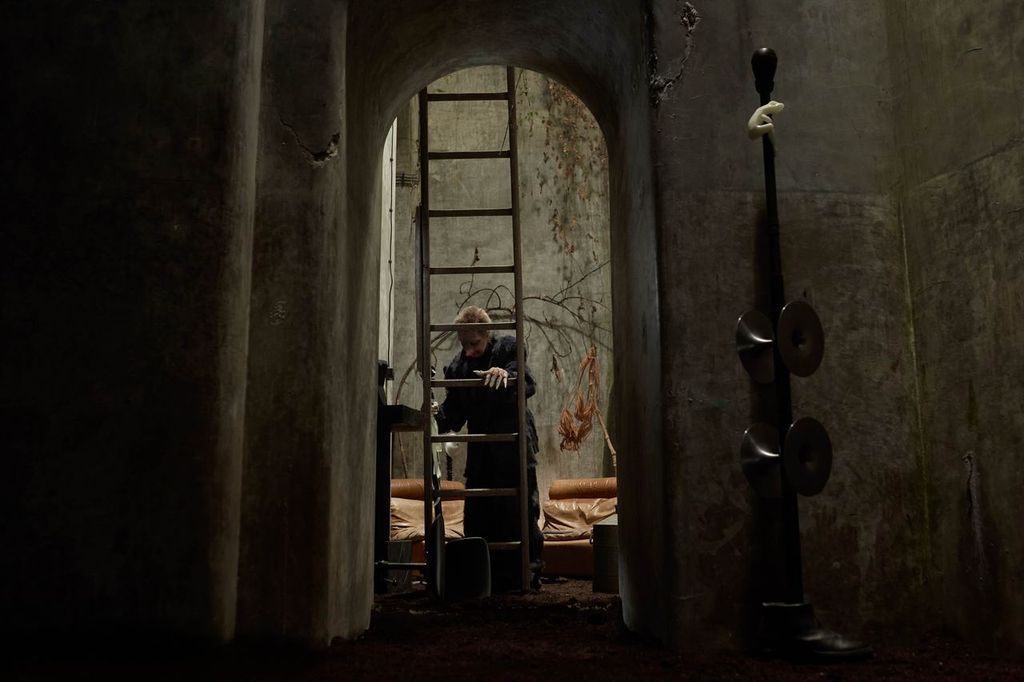
At the Lithuanian Pavilion, the two films in Eglė Budvytytė’s animism sings anarchy, curated by Louise O’Kelly, both build on her earlier moving-image work and open a new chapter in it. Like her recent film (eg., Warmblooded and Earthbound, 2024), which focused on ancestrality, funerary rites, burial sites, and the act of digging into the earth, this new piece also explores where we come from and where we return to, according to certain creation myths. Archaeology, museum displays (some parts of the film were shot in Museo delle Civiltà in Rome), and ritual objects play an important role in Budvytytés’s work. Compared with her earlier films, this one places more emphasis on the references to our contemporary world (including references to technologies such as 3D printers). Throughout the film, shot on 16 mm, the performers emancipate themselves from being custodians in the museum and, through delicate movements of dwelling, climbing, crawling, and lying, they embark on a journey through muddy lands, stony hills, and watery caves (eg., near Grotta Scaloria in Apulia, the site associated with a Neolithic water cult). As the protagonists create facsimiles of anthropomorphic deities, the sculptures we saw in the museum “come to life” through their craftsmanship. They seem connected to fertility, birth, life, and death, emphasizing the circle of life, underscored by the presence of mud, earth, stone, and water in the film. As the curatorial text informs us,[4] the film is inspired by the research of Lithuanian “archeomythologist” Marija Gimbutas and her ideas about Neolithic matrilineal, animist societies. The whole film can be read as a slowly unfolding choreography that leads into a trance-like ritual, commemorating the past.
Air
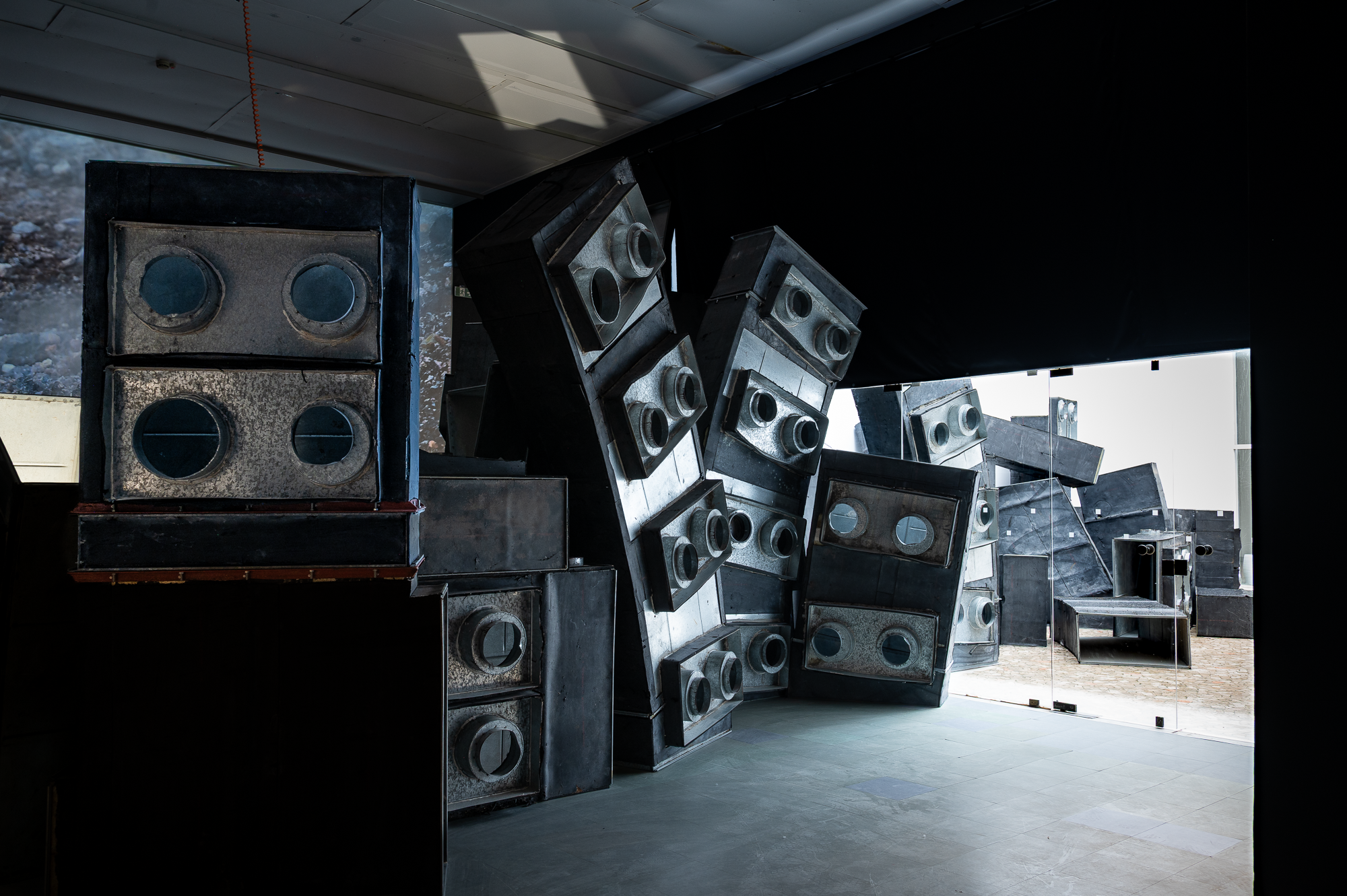
At the Hungarian Pavilion, Endre Koronczi presents Pneuma Cosmic (curated by Luca Cserhalmi), an exhibition that forms part of his long-term Ploubuter park research project. The artist has explored the phenomena of wind and air for several decades, from various perspectives: from biological and meteorological aspects to transcendental and religious understandings. In this project, the entanglement of these two fields is central, connecting the scientific with the spiritual and understanding air movement as “a hypothetical all-pervading, invisible, vitalizing, flowing driving force.”[5] The wind and our breath are on the same platform – interchangeable and connecting the human and more-than-human worlds, as we saw in other national pavilions previously. The central installation is Trapped Breath, consisting of elements of the ventilation system removed from the third floor of the building of the Hungarian Academy of Sciences, during its renovation. The ready-made not only emphasizes the important yet invisible (out of sight) function of the system, but also metaphorically captures and preserves “the breath, sighs and oxygen flowing through the brains of the great minds of academic life”.[6] For me, the installation also speaks to the damage the previous Fidesz government inflicted in Hungary’s cultural and wider intellectual life, for example, the dismantling of the Hungarian Academy of Sciences. As the Fidesz regime took every opportunity to underfund the cultural and scientific scene, leaving it struggling to survive, the presentation of the enormous black ventilation system can also symbolise the “air of freedom” that still remained in these institutions and in the people who worked there. The huge moving-image work about a “breathing landscape” counters the brutal objects in a poetic way.
Fire
Not part of the National Pavilions but a collateral event organised and curated by Fondazione Between Art Film, the exhibition Canicula (curated by Alessandro Rabottini and Leonardo Bigazzi) is one of the highlights in Venice and therefore important to mention. As in the two previous editions, Penumbra and Nebula, the current show takes another meteorological phenomenon as a starting point, which couldn’t be more relevant in 2026. Canicula refers not only to the hottest days of summer but also to the current ecological, political, and economic turmoil in the world. As it is stated in the curatorial text: “the exhibition concept for Canicula is inspired by the phenomena of extreme light and heat as material and metaphorical frameworks, in which matter, people, and ideas are put under pressure. Image overload, information distortion, memory saturation, abuses of power, and oppressive temperatures are taking societies – and, indeed, the Earth itself – to the very brink of collapse.”[7] The newly commissioned video works are not only perfectly installed – the budget is obviously huge here – but most of them tackle these questions from various perspectives and in surprising ways. The venue, the Complesso dell’Ospedaletto as a former hospital and later a care home, gives the exhibition an inspiring backdrop, but for me the key point was that even though it presented only moving-image works, it never once became boring or repetitive. I want to highlight two works connected to Central and Eastern Europe, although the first is by an artist not from the region: Lawrence Abu Hamdan. The fifteen-channel video installation 450XL. The Story of a Fugitive Sound recounts the shocking event of how, during the recent student movements in Serbia, in one of the silent vigils, the government used a sonic weapon known as LRAD 450XL against its citizens. Through his audio research agency, Earshot, the artist conducted interviews and processed emails to uncover this information, which could be seen as one of the first governmental attempts to silence and threaten its people by using this “invisible” sound weapon. It is striking to read the eyewitness accounts on the screens about how shocked the peaceful crowd was when they realised that there is no “real” threat, that it is “only” sound which is attacking them. The work draws attention to both the psychological and physical effects described in the testimonies. We read the accounts from the many screens, yet there is no diegetic sound, only the reconstruction of the LRAD weapon by Earshot at one moment, for one minute, which is truly terrifying. It is especially striking to think about this work now, since the Serbian government was defeated in the October elections and a new era in the country could start.
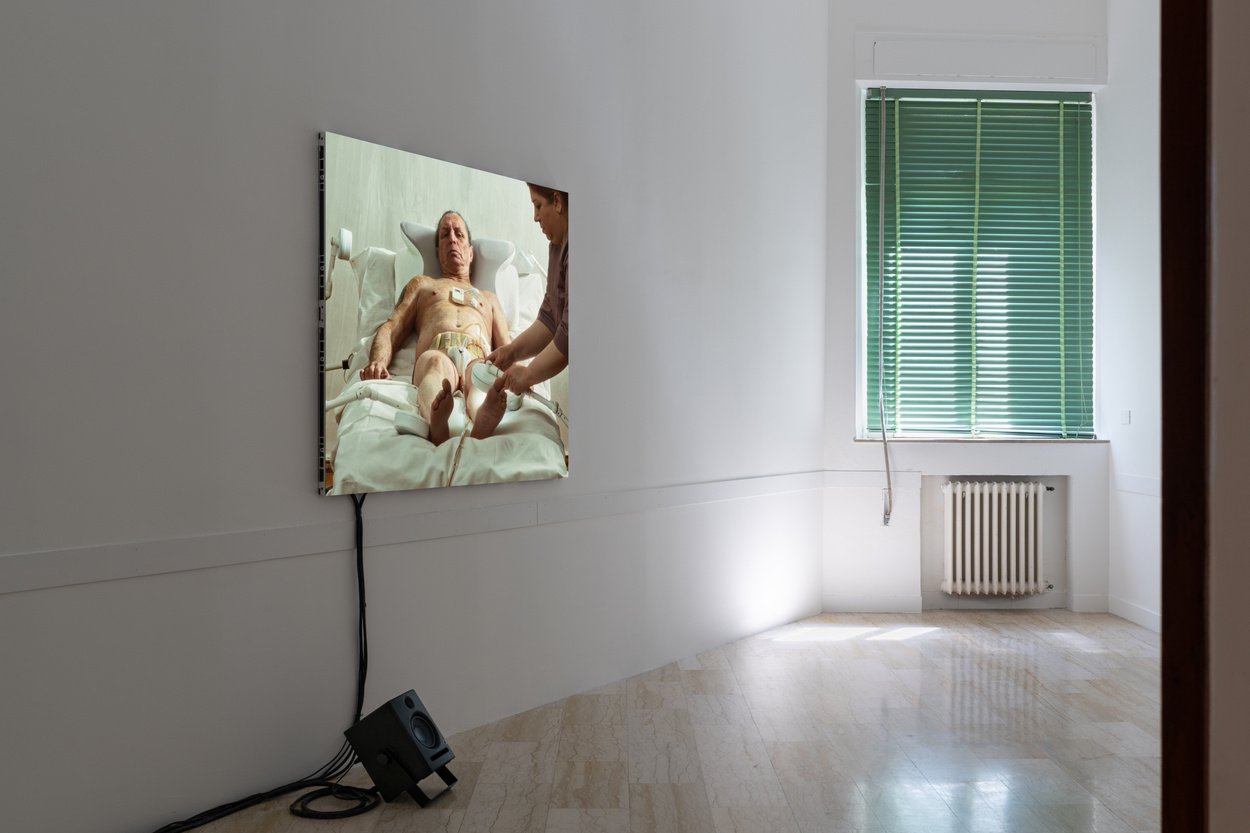
The last work in the exhibition, Wishful Thinking, is by the Ukrainian artist duo Roman Khimei and Yarema Malashchuk, whose projects have appeared in recent years at various biennials and festivals, and are memorable for their provocative minimalist approach. Here, they present a multi-channel video installation across several rooms, with images shown at different scales. It is set in a utopian future in which the war between Russia and Ukraine is finally over. We hear personal accounts from Russian soldiers (played by well-known Ukrainian actors) who share stories of regret, despair, ignorance, and denial. The confessions are disturbing and shocking: they highlight how propaganda and the denial of the truth (for various reasons) can alter one’s thinking. Yet the videos play with the effect of looking at elderly characters, possibly at the last stage of their lives (there is an ex-soldier in his hospital bed), and feeling strangely sorry for them. It ponders such questions of accountability and forgiveness – whether the latter is possible at all. Through these stories, the many layers of language unfold, from speaking the truth to its distortions and manipulations.
Analyzing pavilions from Central and Eastern Europe as well as some other works, through the perspective of the four elements, we can understand the various ways in which the dominant topic of the climate crisis unfolds in the biennale. I believe that not by addressing these questions directly, but through focusing on concrete examples, local narratives and stories, the effect could be much more memorable and distinctive.
61st International Art Exhibition of La Biennale di Venezia (curator: Koyo Kouoh), Venice, Italy, 9 May – 22 November 2026
Cover: Opening Étude, Seaworld Venice 2026 © Nicole Marianna Wytyczak
[1] Quotation from the concept.
[2] Quotation from the curatorial text.
[3] Quotation from the artistic concept.
[4] Quotation from the curatorial text.
[5] Quotation from the concept.

Gadó Flóra
Flóra Gadó is an independent curator, art critic and researcher based between Brussels and Budapest. Between 2018 and 2025, she worked as a curator at the municipal contemporary art center, Budapest Gallery, and has curated various exhibitions, for example, at Kunsthalle Exnergase (Vienna), MeetFactory (Prague), and Trafó Gallery (Budapest). She holds a PhD in Film, Media, and Cultural Studies from Eötvös Loránd University, Budapest and graduated from the MA Curatorial Practice Program at the University of Bergen, Norway. Her curatorial residencies include Firestation Artists Studios (Dublin), MeetFactory (Prague), KAI (Tallinn), Mondriaan Fonds (Amsterdam) and Frame Finland (Helsinki).
You may also like

Alternative Realisms
The January Exhibition recommendation of Kontur Magazine.

Instead of a Top List: Inspirations and Stories from 2025
The Kontur Magazine year-end article, in which the editorial team and some of the magazine’s autho

The Fragile Layers of Our Identity
Kontur Magazine's February Exhibition Recommendation.